Que Doloroso by Arany Zoltán is an Ecuadorian
style folk song played with
the panpipe, guitar, mandolin, shaken percussion, voice and struck, non-pitched rattle.
the panpipe, guitar, mandolin, shaken percussion, voice and struck, non-pitched rattle.
From Arany’s website:
Arany
Zoltán was born in 1976 Debrecen, Hungary. He began to play music at the age of
four. Later studied cello and guitar. At 20 years of age he turned to folk
music and medieval music. At first he played mandolin and later learned to play
multiplicity of instruments. In these last fifteen years he played in many
groups exploring various different styles. He has experience in many styles of
folk music and medieval music as well.
One of the issues that music teachers face in a musically
prolific and diverse culture is giving students the ability to listen
critically to music in such a way that they can discern what they are hearing
and then be able to recreate the sound when needed. Ethnomusicologists have
paved the way by helping to classify musical sound into categories that help
discern what instrument is being utilized. There are many different systems
throughout the world. The ancient Chinese system was based on eight sounds,
depending on the material of which the instrument is constructed. The Indian
system centered around what part of the instrument vibrated to create sound—the
body, a membrane, a string or column of air. The European system, of which I am
most familiar, was based on the parts of the orchestra—strings, winds,
percussion and keyboard. Simple systems developed in Africa and in ancient
Greece placed instruments into two categories. No matter the construct, all of
these systems have the same goal: to adequately describe and categorize
instruments of similar sounds. The most extensive of these systems is based on
Victor Mahillon’s four categories, expanded by Sachs and Hornbostel to include
subcategories. Air, membrane, strings and the instruments body serve as the
major categories—aerophone, membranophone, chordaphone and idiophone. More
recently electronically generated sounds have been added to the system,
electrophones. The ability to identify, adequately describe and categorize an
instrument is a tremendous benefit to the creation and sustaining of musical
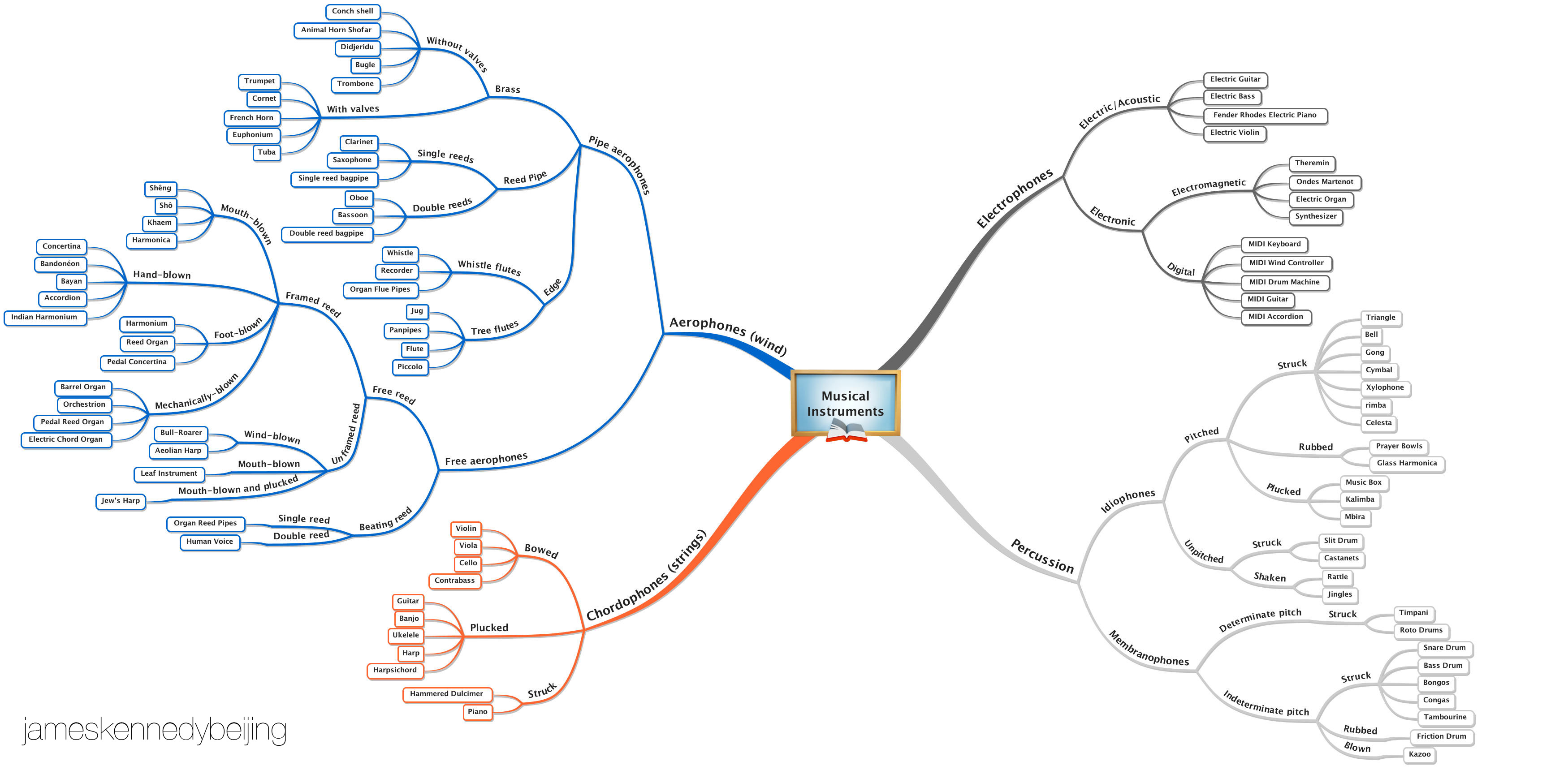
tradition. The excellent diagram below shows the basis for each category and
subcategory along with how each is differentiated.
In the piece above you hear a shaken, non-pitched rattle
instrument enter at 0:34. At the same time, and in the background, there is
also another non-pitched struck rattle sound that at first sounds like
distortion due to the fidelity of the recording but upon continued listening we
recognize that it comes in at specific points of the piece in tempo. Also, in
the plucked chordaphones you can hear the timbre of two different instruments,
the guitar and a mandolin style, small body guitar. Being able to hear and classify
these instruments help us better enjoy, understand and document the piece.
Taxonomy of
Musical Instruments Mind Map by James Kennedy, Beijing,
based on the Hornbostel & Sachs (1914) method of classifying musical instruments.
based on the Hornbostel & Sachs (1914) method of classifying musical instruments.

Flawless incorporation of the prompt, Stephen! This diagram is most helpful and I hope your peers will find a way to your post so they can put it to use.
ReplyDelete